


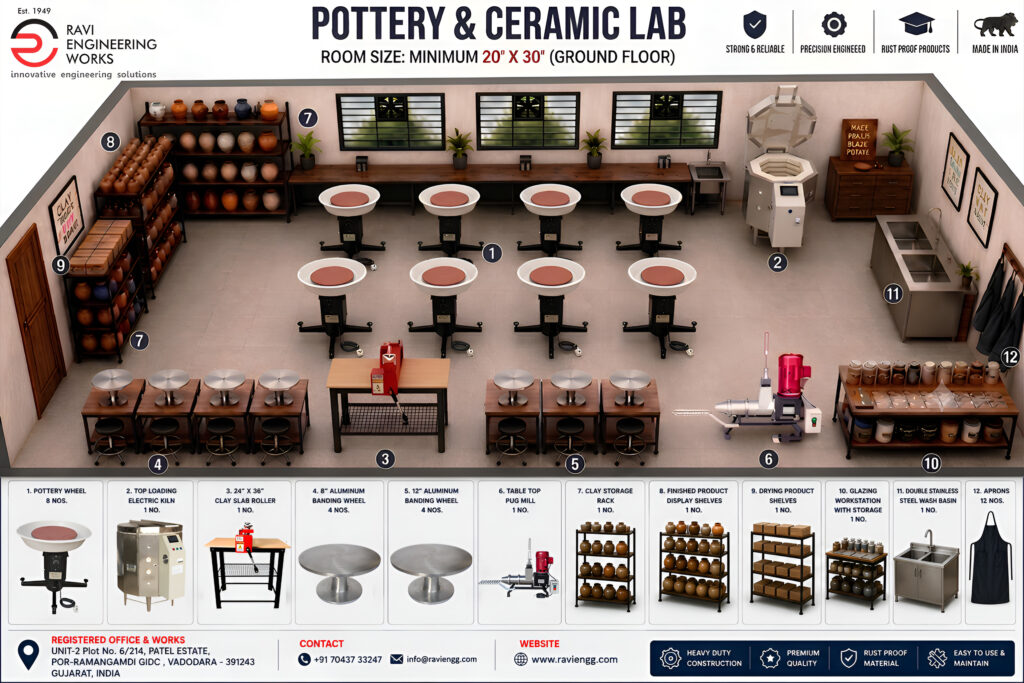
Here are the main reasons schools benefit from having a pottery lab:
- Develops Creativity
- Encourages imagination and original thinking.
- Allows students to transform ideas into physical objects.
- Improves Fine Motor Skills
- Clay work strengthens hand-eye coordination, finger control, and dexterity.
- Particularly valuable for younger students.
- Enhances Concentration and Patience
- Pottery requires careful attention at every stage—from shaping to glazing and firing.
- Teaches students that quality work takes time.
- Promotes Problem-Solving
- Students learn how to correct cracks, warping, glazing issues, and firing defects.
- Builds analytical thinking through experimentation.
- Supports STEM Learning
- Introduces concepts such as:
- Material science
- Chemistry of glazes
- Heat transfer and firing
- Thermal expansion and shrinkage
- Engineering processes
- Introduces concepts such as:
- Reduces Stress
- Working with clay is calming and therapeutic.
- Helps improve emotional well-being and mindfulness.
- Builds Confidence
- Completing a finished ceramic piece gives students a strong sense of achievement.
- Encourages perseverance through trial and improvement.
- Develops Entrepreneurial Skills
- Students can learn product design, pricing, branding, and selling handmade ceramics.
- Useful for vocational education and future careers.
- Encourages Teamwork
- Students share equipment, collaborate on projects, and help one another.
- Builds communication and teamwork.
- Career Exposure
- Introduces opportunities in:
- Ceramic engineering
- Product design
- Fine arts
- Architecture
- Industrial ceramics
- Pottery and studio practice
- Introduces opportunities in:
Benefits for the School
- Enhances the school’s creative learning environment.
- Supports experiential, project-based education.
- Improves students’ portfolios for art and design programs.
- Attracts parents seeking holistic education.
- Enables participation in art exhibitions, competitions, and community events.
Why Schools Are Increasingly Investing in Pottery Labs
A well-equipped pottery lab helps students develop 21st-century skills—creativity, critical thinking, collaboration, communication, and practical problem-solving. It bridges art, science, and engineering in a way that few other school facilities can.
For schools, a pottery lab is an investment in creative education, experiential learning, and lifelong skills, not just an art classroom.